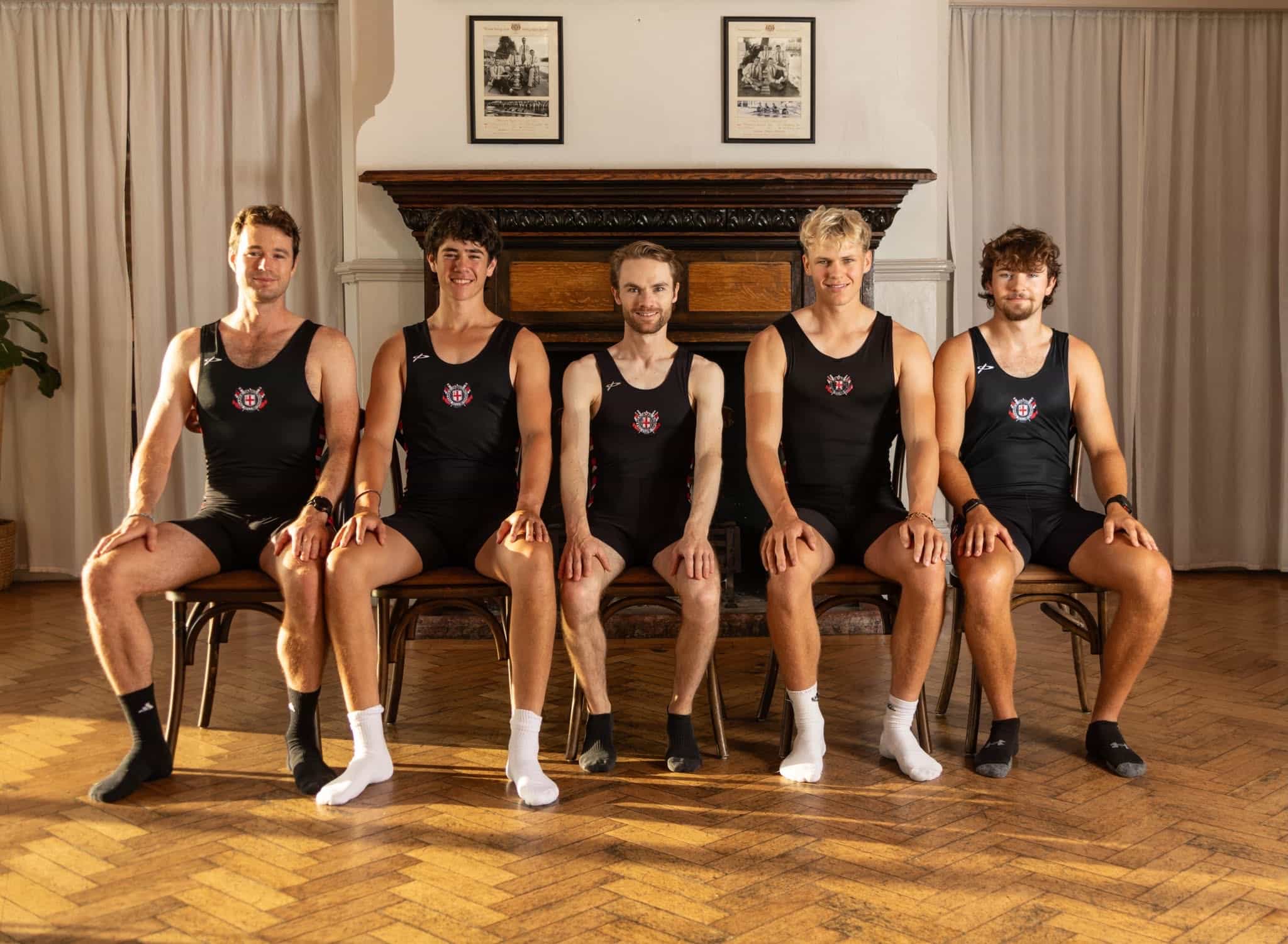
The Thames RC Britannia Challenge A Crew (Tom is far left)
When Tom Bone left Wellington for London for work in 2024, he knew he’d be joining a rowing club but he didn’t fully appreciate just how intense British club rowing would prove to be.
Less than two years later, the former Wellington Rowing Club rower has competed at one of the sport's most famous events, representing Thames Rowing Club at Henley Royal Regatta in the Britannia Challenge Cup for club coxed fours.
For generations of rowers, Henley has occupied an almost mythical place in the sport. Its centuries-old traditions, unique head-to-head racing format and famous riverside setting make it unlike any other regatta in the world.
"It really is everything people say it is," he said. "It's hard to compare it to anything back home. The racing is incredible, but it's also everything happening around you. There are people lining the banks, spectators on boats, everyone is shouting as you're paddling to the start. It's an amazing atmosphere, but there's also so much going on that you have to work really hard to stay focused."
Tom joined Thames Rowing Club shortly after arriving in London. Recognised as one of Britain's powerhouse clubs, Thames fields dozens of high-performance athletes every season and has become a regular contender across Henley's premier events.
Balancing that environment with a full-time career has proved to be one of the biggest challenges for Tom.
After working for KPMG in New Zealand, Tom now works for an international schools group based in Wimbledon. Living close to both his office and the club has helped, but even then the demands have been significant.
"I think this year was probably harder than my first year with Thames," he said. "Last year I wasn't too worried about what boat I was in because I was just happy to be rowing again after a bulged disc. This season there was a lot more pressure around selection, and balancing that with work definitely made it harder."
That pressure comes not just from racing other clubs, but from earning a seat within Thames itself.
Many New Zealand clubs are limited in the boats they can put out by relatively small squads, Thames begins each season with around 60 to 70 athletes trialling for places. After a series of fitness tests, on-water assessments and cuts, only the strongest remain in contention for the club's top boats.
"It's a completely different environment," Tom said. "Everyone is trying to move one seat higher, and the person above you knows that. That pushes them harder as well. The competition inside the squad is probably just as tough as the competition against other clubs."
The depth also drives an exceptionally high standard.
"I think club rowing in the UK feels more developed than it is in New Zealand," he said. "The use of telemetry is much more common, people have often been exposed to that since they were at school, and the competition means everyone keeps improving."
The season itself is split in two. Winter is dominated by head races on London's Tideway, often in cold, grey conditions. Once Easter arrives, the focus shifts to side-by-side racing and, ultimately, Henley.
Thames's preparation included the major Wallingford, Metropolitan and Marlow regattas, as well as a nine-day training camp in Spain.
Those performances earned the crew automatic qualification for Henley, avoiding the qualifying races held the previous weekend.
Instead, the crew completed a final training camp near Henley before moving into the regatta itself.
"It's quite different for the crews who have pre-qualified because you don't actually arrive at Henley until you're ready to race," Tom said. "You're trying to stay in your own bubble, but it's difficult because there's just so much happening."
The atmosphere struck him immediately.
"You can't row down to the start without people yelling your club's name or calling something out. The spectators are so close that it almost feels like they're sitting on top of you. Then you've got all the pleasure boats and umpires moving around you as well. There's really nothing else like it."
One of the traditions Tom particularly enjoyed was the "clap out", where club members line the boat tents to applaud crews as they leave for racing.
"That's really special," he said. "People who raced earlier in the week or former members all come down to support the crews that are still competing. It makes you realise you're representing something much bigger than just the four people in your boat."
After winning their first race, the luck of the draw saw Thames go up on the second day against one of the event favourites from the Netherlands, who eventually went on to win the Britannia Challenge Cup.
"We got to about 700 metres to go and our coxswain called for one final push," Tom recalled. "That was almost the last thing I heard because the crowd became so loud. Once you get down near the enclosures, the noise is incredible."
Away from the racing, Henley also exposed Tom to one of British rowing's more colourful traditions.
"The blazer culture is completely different to New Zealand," he said. "Everyone is incredibly proud of their club colours. Different clubs have different rules about when you've earned a blazer or a cap, and people wear all sorts of bizarre colour combinations. You can almost read someone's rowing history from what they're wearing."
Leaving aside the traditions of one of the major events on the British social calendar, the regatta also reinforced how serious British club rowing has become.
"There are definitely people treating club rowing almost like a full-time job," he said. "In my four, three of the rowers were students, so they could train a lot more than those of us working. Club rowing here has become much more professional than anything I’ve seen back home."
With the season complete, Tom now has a two-month break before the next campaign begins in late August. Whether he returns for another full season is something he is still weighing up.
A niggly back, the enormous commitment required and a desire to spend more time with his partner have all prompted reflection after two demanding years.
"I'd love to win Henley one day," he said. "But there's a difference between liking the idea of winning Henley and wanting to do everything that's required every single day to actually make it happen."
While Tom may still be deciding what the next chapter looks like, one thing is certain: the move to London has given him a front-row seat to one of the world's great rowing cultures.
"It's been an incredible experience," he said. "Henley is one of those places every rower wants to race, and I'm really grateful I got the chance."
Article added: Thursday 09 July 2026