
Association Croquet is a challenging and intriguing sport requiring tactical ability, judgment and skill rather than strength and fast reflexes. And to dispel the myth that croquet is a vicious game of hitting your opponents balls into the shrubbery, any ball leaving the lawn is immediately brought back on to the 'yard' line. The game is played as singles or doubles but in either case the blue and black balls always play against the red and yellow balls. In singles, each player uses both balls, in doubles one each.
The Object of the Game is to make both balls of your side pass through all the hoops in order and then hit the peg before your opponent. The first hoop has a blue top and the last hoop to be run, 'rover' has a red top. After the sixth hoop, you run the six hoops again in the reverse direction; hence they are named 'one-back, two-back', etc. until the 'penultimate' hoop and finally rover. See diagram for the route. Coloured clips are placed on the hoops to remind players (and show spectators) which hoop a has to run next. They are placed on top for the first time through, on the side for the return journey.
To Begin a Game the balls are played onto the lawn one at a time, alternatively each side, from either A or B baulk (see diagram below). After that the player can choose which ball to play during each turn. At the beginning of a turn a player has only one stroke but, depending on what you do, you may gain extra strokes. If your ball hits another ball it is called a 'roquet' and you earn the right to take 'croquet', the stroke that is unique to the game of Croquet and where the fun really begins.
The Croquet Stroke is played immediately following a roquet. You pick up your ball and place it touching the ball you have roqueted. You are then entitled to two more strokes. For the first, you strike your ball in any direction you choose, but ensuring that the other ball moves and provided neither ball goes off the lawn you can play a second, or continuation, stroke. The croquet stroke is the most exciting stroke in the game and can be played in numerous ways to control both balls. By varying the angle at which you strike and the degree of force and the follow-through applied a skilful player can send both balls to very accurate destinations which will enable the break to be continued.
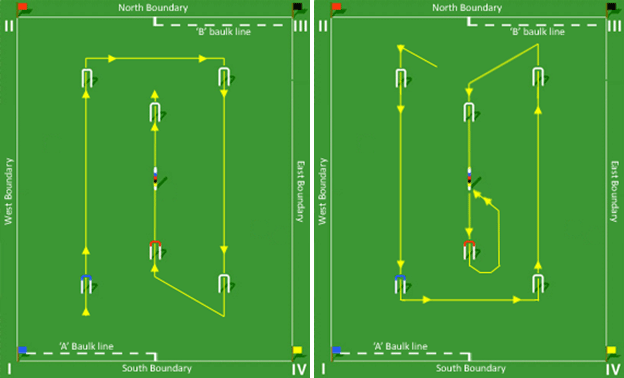
Building a Break is made possible by earning these extra strokes. At the beginning of a turn you may roquet the other three balls and take croquet from them just once but the moment you run a hoop in order you may roquet the all three balls again. Thus it is possible to run several hoops in one turn. Skilful players often run all twelve hoops in one turn; they may even manage to send their partner ball through some of its hoops. This is called 'peeling' and forms an important part of the Advanced form of the game. In case you are thinking this seems too complicated, don't be disheartened, there are simpler forms of the game. Golf croquet, one-ball and short croquet are versions which have their own particular requirements of skill and tactics. See the Golf Croquet page.
The Lawn: a full-size lawn is 35 by 28 yards. Size can vary, especially for garden croquet, but it is a good idea to keep the 5:4 ratio.
Who can play? Everyone. It's a sport suitable for all ages and both sexes and one of the few sports that men and women can play on equal terms. It has a really good handicapping system which , more than any other sport, is a genuine leveller. A weaker player can play an international and have an equal chance of winning.
What does it cost? Many clubs offer beginners provisional membership and coaching to introduce potential members to the sport and allow then to see if they enjoy the social and sporting aspects of croquet. You must have flat-soled shoes and eventually your own mallet. Beginners are encouraged to borrow club mallets for the first season so that when buying their own they will know the weight and dimensions to suite them. This is the only real expense apart from the club subscription.
What to do next? Visit the Clubs & Contacts page to get in touch with a club nearest you. You'll find additional information about how to play croquet on the coaching and links pages.

 Admin Login