















#ThrowbackThursday – A Look Back at New Zealand’s Rugby League Annuals
By Wellington Rugby League Historian, Carey Clements
Since 1935, the New Zealand rugby almanack has delighted historians, statisticians and fans with its annual publication.
What is not so well known however is that rugby league first conceived this idea two years earlier, when the Auckland Star sports reporter Eric Bennetts, lovingly put together a 260-page illustrated annual, covering provincial and New Zealand international histories up until 1933.
Such was his modesty that Bennetts opted to use the nom de plume of ‘Bunty’ in a book that was published by New Zealand Newspapers Ltd. Today for any league fan that follows the game in this country, it is an essential buy, but given the rarity and now high cost of it, most will have never set site on it.
Sadly, the amount of work that Bennetts (who later died as an unrecognised league historian in Auckland in 1967 aged 74), was soon short lived, as the cost of it was far too much for purchasers, who at the time were still living in the shadow of the Great Depression.
The next time a local league annual appeared was in 1947 when the 1919-20 Kiwi and NZ Herald league correspondent of 40 years, Bill Davidson, put out a 96-page publication, covering the game from throughout the country from 1947 to the present year. Although a lot thinner than Bennetts’ remarkable work, there was much to admire in Davidson’s effort. This obviously was reciprocated by readers, which allowed Davidson to publish another annual the following year, before it was time to call it a day.
14 years and much lost history was to pass before the next annual came out under the editorship of the Auckland league writer, Bruce Montgomerie. Enterprising and sensing the time was now right for this publication to get started again, Montgomerie faithfully produced his smaller annuals, that for the next seven years were 64 pages in length, until his last published one in 1969, reached just 48 pages.
By this stage, Montgomerie had done his dash and although he produced individual Kiwis biographies in a 2004 book entitled Those Who Played, he chose the live the last 30 years of his life in Sydney, before dying there in March 2023, aged 89. Like Bennetts earlier, Montgomerie was never fully recognised for his contribution to New Zealand league history. Davidson (who died in 1977 aged 80) was at least later recognised with a New Zealand Rugby League Life Membership, but that was mainly due to being on firstly the Auckland and later NZRL boards.
After Montgomerie had bowed out of his annuals, the 1971 Kiwis co-manager Bill O’Callaghan, took over the running of the publication between 1971 and 1974, before the fifth editor, Gary Wilson, took over the following year. Unlike his predecessors, Wilson, was a professional journalist, that cared little for the game and instead, pierced together the 96-page annual, which was sponsored by Air New Zealand. In a brief editorial, Wilson summed up the problem: “There are difficulties in documenting a season of the game because rugby league doesn’t abound in reliable statisticians any more than it does in world-beating prop forwards”.
The frustration that Wilson endured in trying to get season results from throughout the country, was enough for him to say one year only, before his unshackled of his written and illustrated burden.
Up until then all the writers had been Auckland based, but it then took the former 1954 West Coast Schoolboys Kiwis and current Wellington Rugby League Secretary-Treasurer, Bernie Wood, the conviction to then take over. At the time it seemed perfectly natural that he should fit into this role, given his love of history of league, his administrative involvement in it and also his writing about it, which began with published club reports in the local Wellington newspapers in the early 1970’s. To ensure that he could write for various publications, but not be seen as one with a conflict of interest, he wrote under the ghost name of ‘John Joseph’ for several years.
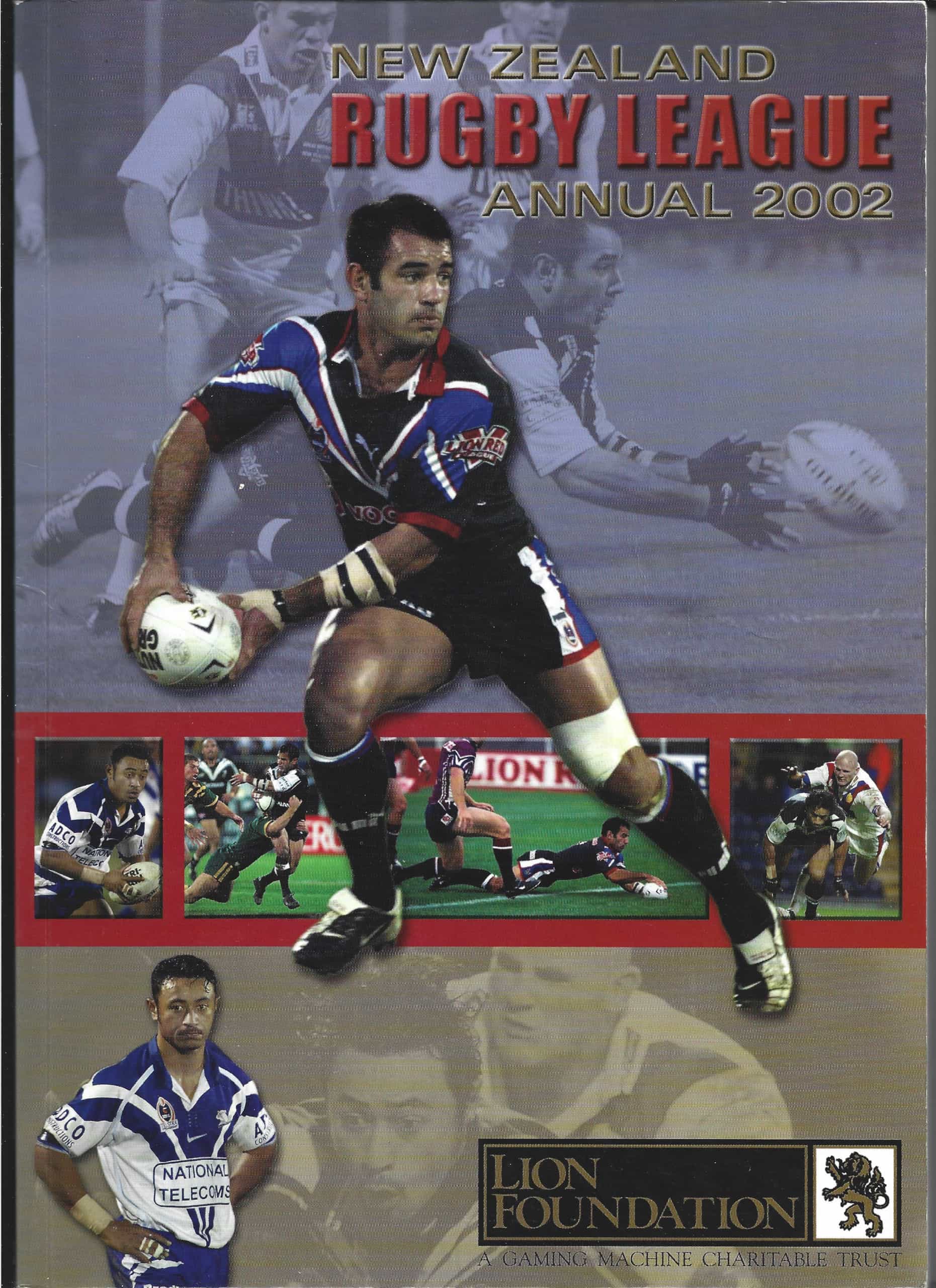
Although Bernie Wood’s first annual came out in 1977, it covered the previous season. Direct, but fully passionate about the 13 a side code, Wood soon found the missing ingredients that were needed, when developing a nationwide contacts database of those that could assist. Aside from 1981 when he put out a history of the New Zealand Cup, Flying Sulkies, Wood then became the face and written mouthpiece for New Zealand rugby league history until 2002.
Not always popular and very opinionated around what provinces or affiliates should get bigger or hardly any coverage, Wood was nevertheless a workhorse, that always would go into reading libraries and find out what was happening in league from the many New Zealand newspapers scattered from throughout the country.
One of Wood’s most trusted lieutenants was another former West Coaster, John Coffey, who been the rugby league writer on the Christchurch Press since the late 1960’s. Add to that, Wood got the Wellington Referees Chairman, Des O’Sullivan, to research into the match officials of Tests from when they began in 1908, while also using other reliable stalwarts such as Peter Kerridge (West Coast), Peter Bidwell (Wellington), Carey Clements (Dunedin), Shane Hurndell (Hawkes Bay), Terry Power (Waikato), Mac Henry (Invercargill) and Gary Frew (Northland), to contribute with written articles and photographs.
In doing so, Wood was effectively like a conductor of an orchestra. His control set the tempo each year, and this resulted in the annual successfully coming out before Christmas every year. In doing so, it became for more than 20 years, one of the must have Christmas presents for every league fan in New Zealand.
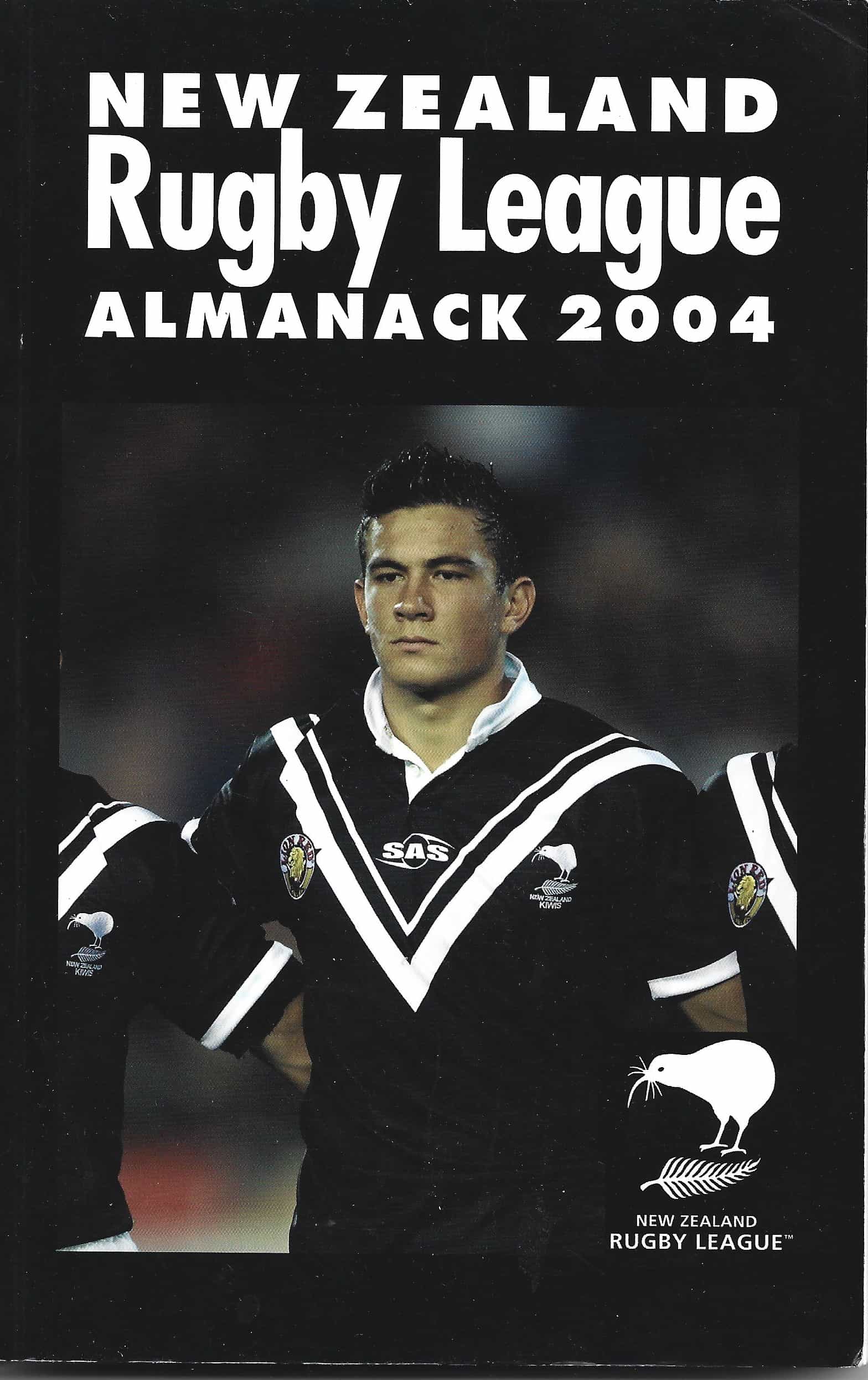
Outspoken as ever, Wood towards the end, divided some by thinking he was only in it for himself, and this was not helped by being a council member on the NZRL Board for many years, while at the same time remaining on the Wellington Board as the Chairman until the early 2000’s. The NZRL also sensed that something was not right and following Wood’s last annual in 2002, the national body took away his power by employing the Auckland cricket statistician, Francis Payne, to edit the now named New Zealand Rugby League almanack for two years in 2003-04.
A methodical researcher, Payne, did an admirable job for two years, but with fewer photos and no historic articles or editorial to go with it, the almanack, came across as a no thrills publication, even though it widely covered the game in the geographic sense.
Like Wood, Payne also experienced troubles with the national body around a pay dispute, and after two years, the publication quietly ceased with no fanfare.
Although disillusioned with the way the game was being run at a higher level, Bernie Wood still contributed to league at local level for several years by Chairing the Porirua Vikings Rugby League Club and leading an extensive fundraising drive for an artificial turf to be laid down at Ascot Park.
In addition, he writing mojo returned, beginning with his magnus opus, The Kiwis in 2007, followed by 100 Years of Māori Rugby League 1908-2008, in 2008, 100 Years of Auckland Rugby League in 2009, and lastly two centennial publications around the Petone Rugby League and the Wellington Rugby League in 2012. By this stage, his poor personal health started to kick in, resulting in his death in April, 2013. He was aged 73.
This year of 2024 now marks 20 years since the New Zealand League Almanack was last published. In that time, the Kiwis have won the World Cup and the game has had been on a roller coaster ride, through success and also failure.
Individuals have come and gone, but the most important thing that has gone is the history of the game in New Zealand. Until several years ago, daily newspapers used to give account of club and provincial games. Now aside from independent newspapers like the Otago Daily Times, websites have been relied as the main source of knowledge. But if those sites are taken down for whatever reason, then the game’s history is again set back, which can then only rely on the records kept by either individuals or by clubs.
As a result, the past 20 years, should be recaptured in a written publication, before those that were there during that time are gone forever. And with that also, league annuals should reemerge as well, just as in the spirit that the late Eric Bennetts intended way back in 1933, as well as that of the late Bernie Wood decades later.
Article added: Thursday 18 July 2024