
These articles will help you with your race walking journey. Read the one that is most appropriate for the stage that you are at.
 Getting Started with Race Walking
What is race walking?
Race walking is a genuine athletic discipline, governed by two rules that make it a distinct sport from running or ordinary walking:
The Contact Rule — One foot must appear to stay in contact with the ground at all times. To the human eye, there should be no visible moment where both feet are off the ground together.
The Straight Leg Rule — Your advancing leg must be straightened (not bent at the knee) from the moment it touches the ground until it passes directly under your body.
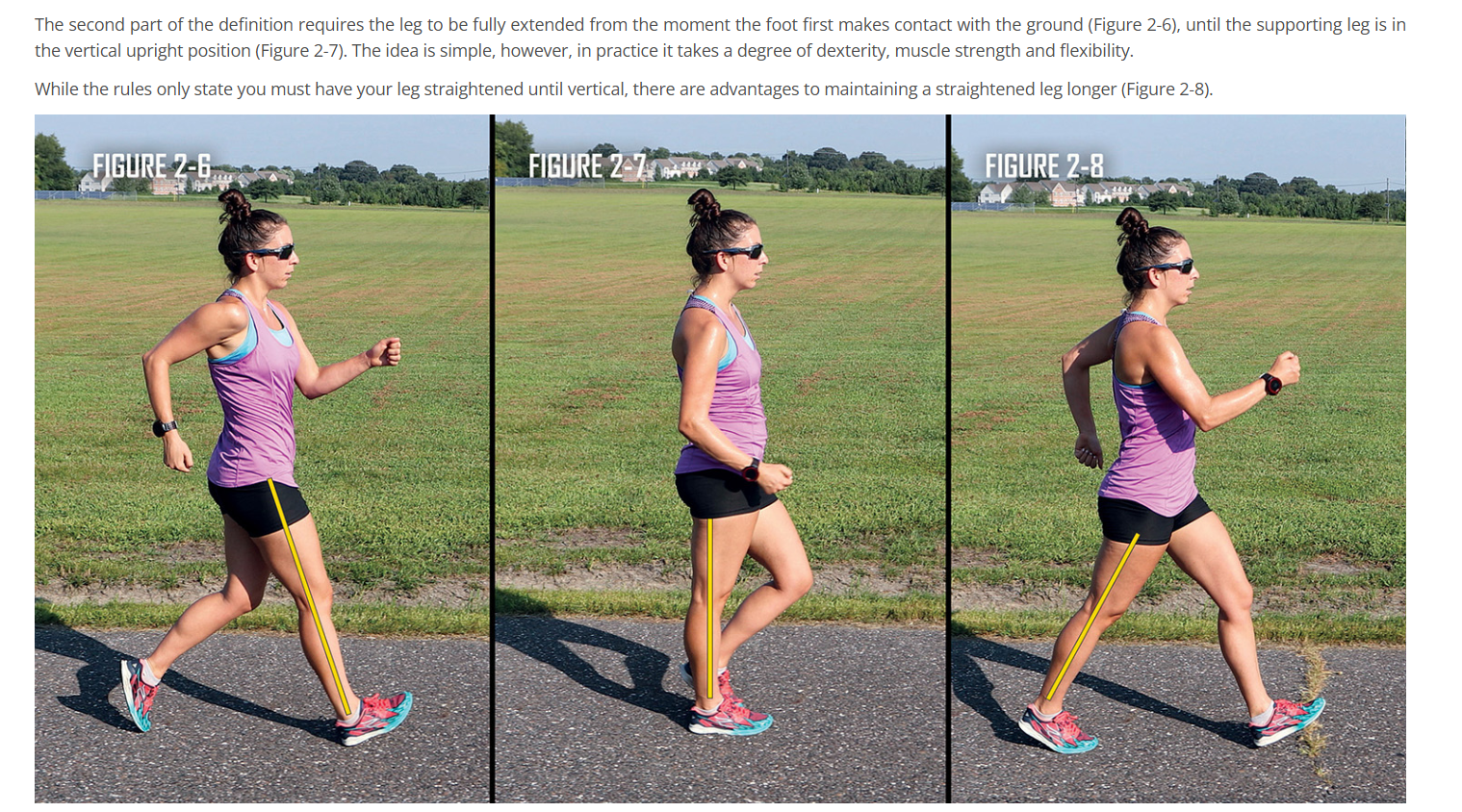
The yellow line tracks the same leg through the stride—straight at contact, straight through vertical, only bending once the walker's weight has moved past it.
These two rules are all you need to know to get started. Everything else — technique, speed, training — builds from getting these right.
(Interesting fact for later: high-speed cameras show that even elite race walkers do have tiny, invisible-to-the-eye moments of “flight.” What matters for the rules is what a judge can see with the naked eye, not what a slow-motion camera can find.)
The basics of good technique
You don’t need to get all of this right on day one — a coach or experienced club member will work through it with you at your own pace. But here’s what to aim for:
Posture: Stand tall. Head up, eyes forward — not down at your feet. Shoulders relaxed and level.
Arms: Bend your elbows to roughly 90 degrees and swing them from the shoulder, hands moving between hip height and chest height. Your arms do real work here — they help drive you forward and keep your rhythm.
Hips: A bit of forward-and-back hip rotation is normal and helps you cover ground while keeping contact with it. This feels strange at first — that’s normal too.
- Legs and feet: Let your heel land first, with the leg straightening as it takes your weight. Keep your feet landing close to an imaginary centre line rather than splayed wide.
What can go wrong (and it’s completely normal that it will, at first)
Loss of contact (“lifting”) — both feet leaving the ground at once. Usually happens when you’re trying to go faster than your current technique allows.
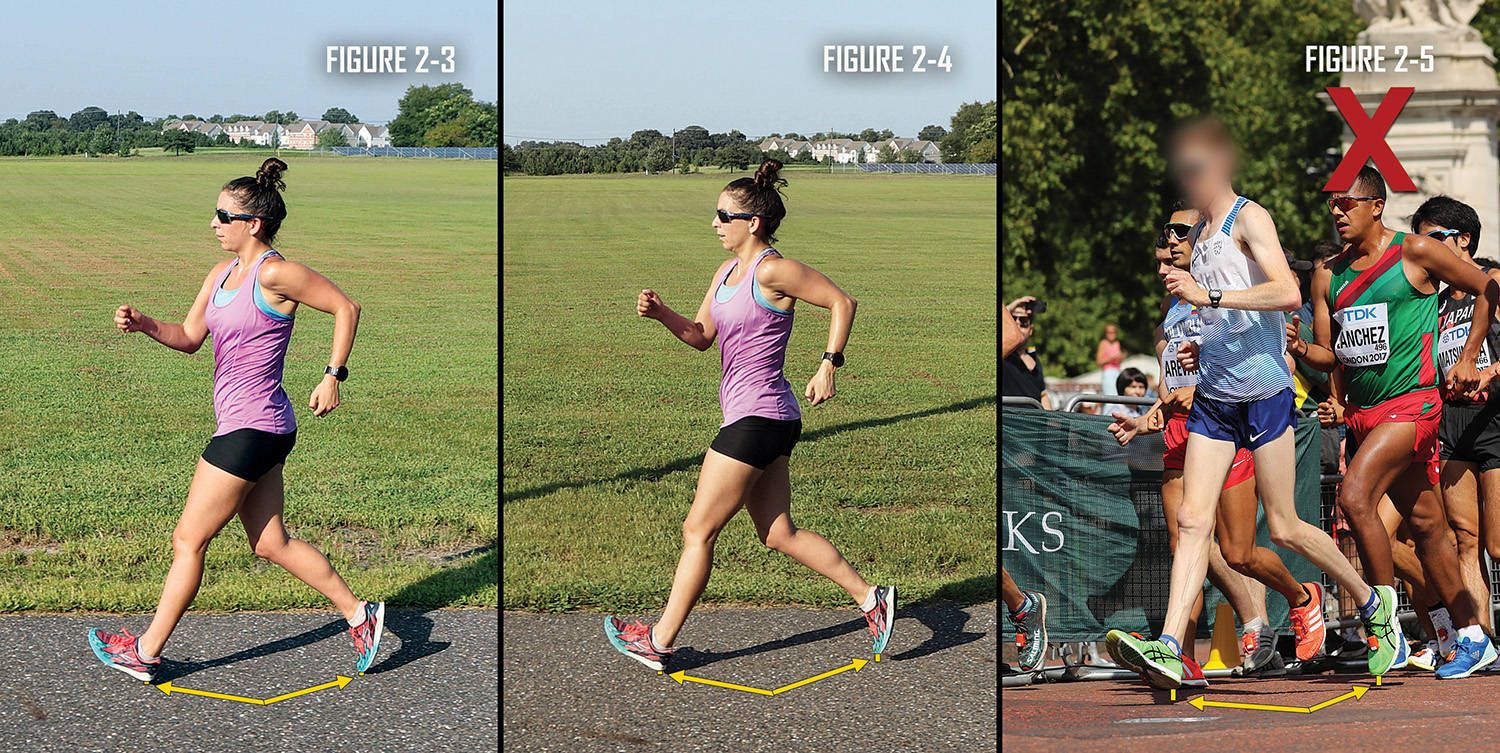
The leftmost walker is barely off the ground—legal. The middle walker has a slightly larger gap, still too small to call. The walker on the right is flagrantly airborne and was disqualified for it.
Photographs and diagrams courtesy of Jeff Salvage, racewalk.com. Used with permission.
Bent knee (“creeping”) — not straightening the leg fully on contact. Often comes down to tight hips or hamstrings, or fatigue.
Every walker in the club has worked through both of these. It’s part of learning the sport, not a sign you’re doing something wrong.
How judging works
At races, judges watch for exactly the two faults above and show paddles as warnings — yellow for loss of contact, red for bent knee. It takes three different judges flagging the same violation for a disqualification. As a newcomer, you won’t be judged in this way at training — judging is a competition thing, and there’s no reason to worry about it while you’re learning.
Staying injury-free as you start out
Race walking is genuinely lower-impact than running, but it’s still a physical sport, and the same rule applies as with any new activity: build up gradually.
Increase your training time by no more than about 10% a week
Take rest days — they’re part of training, not a break from it
Wear shoes with good flexibility and moderate heel cushioning (a running shoe works fine to start; there’s no need for anything specialist yet)
- If something hurts persistently rather than just feeling like normal muscle fatigue, rest and ask — don’t push through it
A simple 12-week plan, if you want a target
This is a general guide for building toward a first 5km — not a strict prescription. Talk to a club coach before starting any structured plan, and adjust it to how your body responds.
Weeks 1–4 — Foundation (assumes you can already walk comfortably for 30+ minutes) - 3 walking sessions a week of 30–45 minutes at an easy pace, plus one longer walk (45–60 min) on the weekend - Rest or light cross-training on the other days
Weeks 5–8 — Building structure - Add one session a week with short bursts of faster walking (e.g. 4 x 2 minutes faster, with 2 minutes easy in between) - Extend your weekend long walk toward 60–75 minutes
Weeks 9–11 — Race preparation - Slightly longer fast bursts within your sessions - Weekend long walk extends to 75–90 minutes
Week 12 — Race week - Shorter, easier sessions through the week - Race day: your first 5km
Come along on a Sunday and we’ll help you fit this — or something better suited to you — into a plan that works.
3. Advanced
 Admin Login